2026
Anna-Kristin Behnert; Oliver Antons; Julia Arlinghaus
In: Bode, Christoph; Bogaschewsky, Ronald; Buchholz, Wolfgang; Eßig, Michael; Lasch, Rainer (Hrsg.): Supply Management Research: Aktuelle Forschungsergebnisse 2026, S. 147–162, Springer Fachmedien Wiesbaden, Wiesbaden, 2026, ISBN: 978-3-658-52933-8.
Abstract | Links | BibTeX | Schlagwörter: Circular Economy, Data Sharing, Procurement
@inbook{Behnert2026,

title = {Data sharing for circular procurement: Uncovering how data sharing can mitigate circular procurement barriers},

author = {Anna-Kristin Behnert and Oliver Antons and Julia Arlinghaus},

editor = {Christoph Bode and Ronald Bogaschewsky and Wolfgang Buchholz and Michael E\ssig and Rainer Lasch},

url = {https://doi.org/10.1007/978-3-658-52933-8_6},

doi = {10.1007/978-3-658-52933-8_6},

isbn = {978-3-658-52933-8},

year  = {2026},

date = {2026-01-01},

urldate = {2026-01-01},

booktitle = {Supply Management Research: Aktuelle Forschungsergebnisse 2026},

pages = {147\textendash162},

publisher = {Springer Fachmedien Wiesbaden},

address = {Wiesbaden},

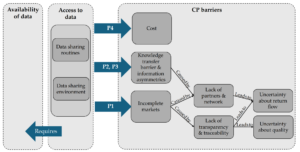
abstract = {Transitioning to a circular economy is critical for companies to achieve long-term economic, environmental, and social benefits in the face of increasing supply chain uncertainties, disruptions and upcoming new regulations. To achieve these benefits circular supply chain management, and especially circular procurement has been identified as crucial enabler. However, existing barriers such as lack of transparency, unavailability of materials, poor quality of secondary materials, lack of cooperation and high costs lead to a situation of unprofitability, and an increase in uncertainties. This paper examines the potential of secure data sharing environments to overcome these challenges and promote circular procurement practices. A systematic review of the existing literature is conducted to identify the key barriers to and potential enabling function of a secure data sharing environment. Subsequently, propositions are derived on the potentials of data sharing to foster circular procurement.},

keywords = {Circular Economy, Data Sharing, Procurement},

pubstate = {published},

tppubtype = {inbook}

}

Oliver Antons; Christoph Legat
Decision-Making in the Era of Data Spaces: Selected Implications on Future Control Engineering Challenges Proceedings Article
In: Trentesaux, Damien; Leitão, Paulo; McFarlane, Duncan; Rosin, Frédéric; Cardin, Olivier (Hrsg.): Service Oriented, Holonic and Multi-agent Manufacturing Systems for Industry of the Future, S. 83–94, Springer Nature Switzerland, Cham, 2026, ISBN: 978-3-032-18786-4.
Abstract | Links | BibTeX | Schlagwörter: Data Sharing, Data Space, Manufacturing
@inproceedings{10.1007/978-3-032-18786-4_8,

title = {Decision-Making in the Era of Data Spaces: Selected Implications on Future Control Engineering Challenges},

author = {Oliver Antons and Christoph Legat},

editor = {Damien Trentesaux and Paulo Leit\~{a}o and Duncan McFarlane and Fr\'{e}d\'{e}ric Rosin and Olivier Cardin},

url = {https://link.springer.com/chapter/10.1007/978-3-032-18786-4_8},

doi = {10.1007/978-3-032-18786-4_8},

isbn = {978-3-032-18786-4},

year  = {2026},

date = {2026-01-01},

urldate = {2026-01-01},

booktitle = {Service Oriented, Holonic and Multi-agent Manufacturing Systems for Industry of the Future},

pages = {83\textendash94},

publisher = {Springer Nature Switzerland},

address = {Cham},

abstract = {The continuous digitization of production facilities, the emergence of modern methods of data processing and advancements in artificial intelligence increase the potential for decision-making processes in industrial control. An ever increasing number of sensors, digital (global) links through data spaces, and integrated supply chain models result in an abundance of input data that can be considered in decision-making processes. At the same time, the objectives of industrial control problems extend beyond mere profit maximization, as shifting societal and political frameworks demands the consideration of ecological sustainability and demographic changes. Subsequently, the complexity of decision-making processes in the industrial context growth analogously, prompting questions regarding meta-decisions regarding which input data to consider and how to weigh different objective functions. In this article, we review current challenges of decision-making in the industrial context and derive a meta-framework supporting both researchers and practitioners in the design of decision-making processes and the associated decision spaces.},

keywords = {Data Sharing, Data Space, Manufacturing},

pubstate = {published},

tppubtype = {inproceedings}

}