2026
Rodrigo Torres Adelsberger; Mathias Vorbröcker; Oliver Antons; Julia C. Arlinghaus
Exploring the Interaction Between Digital Twins and Data Spaces: A Circular Value Creation Perspective Proceedings Article
In: S. 97-106, 2026, ISSN: 1877-0509, (7th International Conference on System-Integrated Intelligence).
Abstract | Links | BibTeX | Schlagwörter: Asset Administration Shell, Circular Business Models, Circular Economy, Data Space, Digital Twin, Industry 4.0
@inproceedings{ADELSBERGER202697,

title = {Exploring the Interaction Between Digital Twins and Data Spaces: A Circular Value Creation Perspective},

author = {Rodrigo Torres Adelsberger and Mathias Vorbr\"{o}cker and Oliver Antons and Julia C. Arlinghaus},

url = {https://www.sciencedirect.com/science/article/pii/S1877050926001286},

doi = {https://doi.org/10.1016/j.procs.2026.02.013},

issn = {1877-0509},

year  = {2026},

date = {2026-01-01},

urldate = {2026-01-01},

journal = {Procedia Computer Science},

volume = {276},

pages = {97-106},

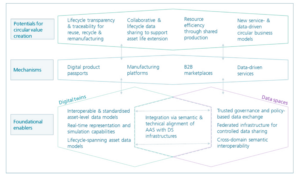
abstract = {Digital Twins and Data Spaces are emerging as key drivers for secure and interoperable data exchange in manufacturing, offering new opportunities to support Circular Economy strategies. While Digital Twins and Data Spaces each contribute foundational enablers, such as interoperable asset data models and trusted policy-based data sharing, their combined potential to unlock circular value creation remains underexplored. We utilise a structured literature review approach to address this knowledge gap and develop a conceptual framework grounded in a Circular Economy perspective. The integration of these foundational enablers can activate four relevant mechanisms (digital product passports, manufacturing platforms, business-to-business marketplaces, and data-driven services) which subsequently may support Circular Economy strategies. These include enhanced lifecycle transparency and traceability, asset life extension through collaborative data sharing, improved resource efficiency via shared production, and the creation of new circular business models. This study has the potential to advance the theoretical understanding of Digital Twin-Data Space integration for circular value creation and provides a foundation for future empirical validation in industrial settings.},

note = {7th International Conference on System-Integrated Intelligence},

keywords = {Asset Administration Shell, Circular Business Models, Circular Economy, Data Space, Digital Twin, Industry 4.0},

pubstate = {published},

tppubtype = {inproceedings}

}
2025
Mathias Vorbröcker; Oliver Antons; Julia C. Arlinghaus
Industrial Data Space Research Konferenz
Service Oriented, Holonic and Multi-agent Manufacturing Systems for Industry of the Future. SOHOMA 2024. Studies in Computational Intelligence, Bd. 1197, Springer, 2025, ISBN: 978-3-031-85316-6.
Abstract | Links | BibTeX | Schlagwörter: Data analytics, Data Space, Gaia-X, IDS
@conference{vorbrocker2025industrial,

title = {Industrial Data Space Research},

author = {Mathias Vorbr\"{o}cker and Oliver Antons and Julia C. Arlinghaus},

editor = {Springer, Cham},

url = {https://link.springer.com/chapter/10.1007/978-3-031-85316-6_12},

doi = {10.1007/978-3-031-85316-6_12},

isbn = {978-3-031-85316-6},

year  = {2025},

date = {2025-07-03},

urldate = {2025-07-03},

booktitle = {Service Oriented, Holonic and Multi-agent Manufacturing Systems for Industry of the Future. SOHOMA 2024. Studies in Computational Intelligence},

journal = {Service Oriented, Holonic and Multi-agent Manufacturing Systems for Industry of the Future: Proceedings of SOHOMA 2024},

volume = {1197},

pages = {163},

publisher = {Springer},

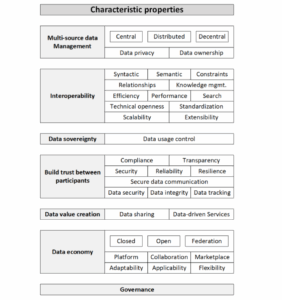
abstract = {In recent years, the topic of data spaces has been increasingly gaining traction. Multiple research initiatives, backed by industrial and government actors have introduced several data spaces for various industries and medicine, and beyond. In order to support value creation, public services and collaboration between a plethora of different participants of the data spaces, the sharing of information and building services and insights thereupon has been identified as key enabler. However, these initiatives differ in various properties from the initial idea for data spaces derived in research. In this article, we review the current state of literature regarding the concept of data spaces and the impact of European initiatives, namely International Data Spaces, Gaia-X and European Health Data Space, on the literature. Identifying characteristic properties of data spaces and its participants, we provide a general overview.},

keywords = {Data analytics, Data Space, Gaia-X, IDS},

pubstate = {published},

tppubtype = {conference}

}
Anna-Kristin Behnert; Oliver Antons; Lena Prieß; Julia C. Arlinghaus
Data-Driven Circularity: The Role of Data Spaces in fostering Sustainable Manufacturing Artikel
In: IFAC-PapersOnLine, Bd. 59, Nr. 10, S. 1241-1246, 2025, ISSN: 2405-8963, (11th IFAC Conference on Manufacturing Modelling, Management and Control MIM 2025).
Abstract | Links | BibTeX | Schlagwörter: Circular Economy, Data Space, Sustainability
@article{BEHNERT20251241,

title = {Data-Driven Circularity: The Role of Data Spaces in fostering Sustainable Manufacturing},

author = {Anna-Kristin Behnert and Oliver Antons and Lena Prie\ss and Julia C. Arlinghaus},

url = {https://www.sciencedirect.com/science/article/pii/S240589632500970X},

doi = {https://doi.org/10.1016/j.ifacol.2025.09.209},

issn = {2405-8963},

year  = {2025},

date = {2025-01-01},

urldate = {2025-01-01},

journal = {IFAC-PapersOnLine},

volume = {59},

number = {10},

pages = {1241-1246},

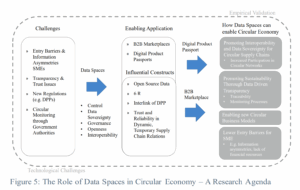
abstract = {The transition to a Circular Economy is critical for achieving sustainable manufacturing. However, challenges such as complex supply chains, lack of transparency and stakeholder collaboration are hindering progress. This paper examines the potential of Data Spaces to overcome these challenges and promote sustainable production practices. A systematic review of the literature and abibliometric analysis were conducted to identify key research areas, geographical trends, synergies and gaps in the intersection of Da ta Spaces and Circular Economy. Subsequently, propositions were derived regarding the potential of Data Spaces to foster Circular Economy. By integrating Digital Product Pass ports and federated B2B marketplaces, Da ta Spaces facilitate recycling, repair and reuse processes, while simultaneously reducing the barrier to entry for small and medium-sized enterprises. The findings underscore the transformative role of Data Spaces in operation a lizingcircular principles. A research agenda is proposed to guide future empirical and theoretical studies in this domain.},

note = {11th IFAC Conference on Manufacturing Modelling, Management and Control MIM 2025},

keywords = {Circular Economy, Data Space, Sustainability},

pubstate = {published},

tppubtype = {article}

}