2026
Lennart Raap; Simon F. Schäfer; Oliver Antons; Julia C. Arlinghaus
Exploring the Impact of Emerging Technologies on the Factory Planning Ecosystem – A Literature Review Proceedings Article
In: S. 275-288, 2026, ISSN: 1877-0509, (7th International Conference on System-Integrated Intelligence).
Abstract | Links | BibTeX | Schlagwörter: Building Information Modeling, collaboration, Digital Twin, emerging technologies, factory layout, Factory planning, stakeholders
@inproceedings{RAAP2026275,

title = {Exploring the Impact of Emerging Technologies on the Factory Planning Ecosystem \textendash A Literature Review},

author = {Lennart Raap and Simon F. Sch\"{a}fer and Oliver Antons and Julia C. Arlinghaus},

url = {https://www.sciencedirect.com/science/article/pii/S1877050926001481},

doi = {https://doi.org/10.1016/j.procs.2026.02.033},

issn = {1877-0509},

year  = {2026},

date = {2026-01-01},

urldate = {2026-01-01},

journal = {Procedia Computer Science},

volume = {276},

pages = {275-288},

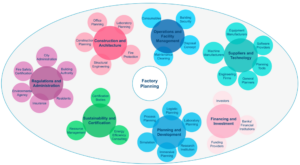
abstract = {The increasing technological and organizational complexity of factory planning necessitates a reconsideration of its underlying structures, processes, and stakeholder interactions. This study investigates how emerging technologies transform factory planning not merely by enhancing existing tasks, but by reconfiguring the socio-technical ecosystem in which planning occurs. Drawing on a systematic literature review guided by the PRISMA methodology, the analysis identifies and categorizes technological interventions across three dimensions: planning processes, collaboration models, and stakeholder constellations. Findings reveal a predominant focus on visualization technologies, while systemic implications for collaboration and actor roles remain insufficiently addressed. By synthesizing these insights, the study introduces a conceptual model of the factory planning ecosystem and demonstrates how technologies such as Digital Twins, Extended Reality, and AI serve as catalysts for more integrated, participatory, and data-driven planning environments. The results provide a foundation for future research on the evolving stakeholder landscape, the institutional integration of planning technologies, and the systemic reconfiguration of collaboration structure.},

note = {7th International Conference on System-Integrated Intelligence},

keywords = {Building Information Modeling, collaboration, Digital Twin, emerging technologies, factory layout, Factory planning, stakeholders},

pubstate = {published},

tppubtype = {inproceedings}

}
The increasing technological and organizational complexity of factory planning necessitates a reconsideration of its underlying structures, processes, and stakeholder interactions. This study investigates how emerging technologies transform factory planning not merely by enhancing existing tasks, but by reconfiguring the socio-technical ecosystem in which planning occurs. Drawing on a systematic literature review guided by the PRISMA methodology, the analysis identifies and categorizes technological interventions across three dimensions: planning processes, collaboration models, and stakeholder constellations. Findings reveal a predominant focus on visualization technologies, while systemic implications for collaboration and actor roles remain insufficiently addressed. By synthesizing these insights, the study introduces a conceptual model of the factory planning ecosystem and demonstrates how technologies such as Digital Twins, Extended Reality, and AI serve as catalysts for more integrated, participatory, and data-driven planning environments. The results provide a foundation for future research on the evolving stakeholder landscape, the institutional integration of planning technologies, and the systemic reconfiguration of collaboration structure.