2026
Rodrigo Torres Adelsberger; Mathias Vorbröcker; Oliver Antons; Julia C. Arlinghaus
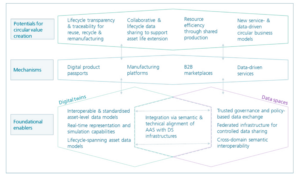
Exploring the Interaction Between Digital Twins and Data Spaces: A Circular Value Creation Perspective Proceedings Article
In: S. 97-106, 2026, ISSN: 1877-0509, (7th International Conference on System-Integrated Intelligence).
Abstract | Links | BibTeX | Schlagwörter: Asset Administration Shell, Circular Business Models, Circular Economy, Data Space, Digital Twin, Industry 4.0
@inproceedings{ADELSBERGER202697,

title = {Exploring the Interaction Between Digital Twins and Data Spaces: A Circular Value Creation Perspective},

author = {Rodrigo Torres Adelsberger and Mathias Vorbr\"{o}cker and Oliver Antons and Julia C. Arlinghaus},

url = {https://www.sciencedirect.com/science/article/pii/S1877050926001286},

doi = {https://doi.org/10.1016/j.procs.2026.02.013},

issn = {1877-0509},

year  = {2026},

date = {2026-01-01},

urldate = {2026-01-01},

journal = {Procedia Computer Science},

volume = {276},

pages = {97-106},

abstract = {Digital Twins and Data Spaces are emerging as key drivers for secure and interoperable data exchange in manufacturing, offering new opportunities to support Circular Economy strategies. While Digital Twins and Data Spaces each contribute foundational enablers, such as interoperable asset data models and trusted policy-based data sharing, their combined potential to unlock circular value creation remains underexplored. We utilise a structured literature review approach to address this knowledge gap and develop a conceptual framework grounded in a Circular Economy perspective. The integration of these foundational enablers can activate four relevant mechanisms (digital product passports, manufacturing platforms, business-to-business marketplaces, and data-driven services) which subsequently may support Circular Economy strategies. These include enhanced lifecycle transparency and traceability, asset life extension through collaborative data sharing, improved resource efficiency via shared production, and the creation of new circular business models. This study has the potential to advance the theoretical understanding of Digital Twin-Data Space integration for circular value creation and provides a foundation for future empirical validation in industrial settings.},

note = {7th International Conference on System-Integrated Intelligence},

keywords = {Asset Administration Shell, Circular Business Models, Circular Economy, Data Space, Digital Twin, Industry 4.0},

pubstate = {published},

tppubtype = {inproceedings}

}
Lennart Raap; Simon F. Schäfer; Oliver Antons; Julia C. Arlinghaus
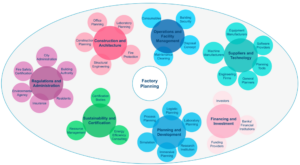
Exploring the Impact of Emerging Technologies on the Factory Planning Ecosystem – A Literature Review Proceedings Article
In: S. 275-288, 2026, ISSN: 1877-0509, (7th International Conference on System-Integrated Intelligence).
Abstract | Links | BibTeX | Schlagwörter: Building Information Modeling, collaboration, Digital Twin, emerging technologies, factory layout, Factory planning, stakeholders
@inproceedings{RAAP2026275,

title = {Exploring the Impact of Emerging Technologies on the Factory Planning Ecosystem \textendash A Literature Review},

author = {Lennart Raap and Simon F. Sch\"{a}fer and Oliver Antons and Julia C. Arlinghaus},

url = {https://www.sciencedirect.com/science/article/pii/S1877050926001481},

doi = {https://doi.org/10.1016/j.procs.2026.02.033},

issn = {1877-0509},

year  = {2026},

date = {2026-01-01},

urldate = {2026-01-01},

journal = {Procedia Computer Science},

volume = {276},

pages = {275-288},

abstract = {The increasing technological and organizational complexity of factory planning necessitates a reconsideration of its underlying structures, processes, and stakeholder interactions. This study investigates how emerging technologies transform factory planning not merely by enhancing existing tasks, but by reconfiguring the socio-technical ecosystem in which planning occurs. Drawing on a systematic literature review guided by the PRISMA methodology, the analysis identifies and categorizes technological interventions across three dimensions: planning processes, collaboration models, and stakeholder constellations. Findings reveal a predominant focus on visualization technologies, while systemic implications for collaboration and actor roles remain insufficiently addressed. By synthesizing these insights, the study introduces a conceptual model of the factory planning ecosystem and demonstrates how technologies such as Digital Twins, Extended Reality, and AI serve as catalysts for more integrated, participatory, and data-driven planning environments. The results provide a foundation for future research on the evolving stakeholder landscape, the institutional integration of planning technologies, and the systemic reconfiguration of collaboration structure.},

note = {7th International Conference on System-Integrated Intelligence},

keywords = {Building Information Modeling, collaboration, Digital Twin, emerging technologies, factory layout, Factory planning, stakeholders},

pubstate = {published},

tppubtype = {inproceedings}

}
2024
Luca Janecki; Oliver Antons; Daniel Reh; Julia C. Arlinghaus
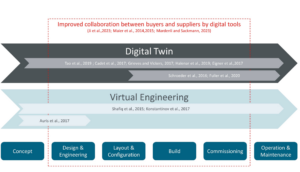
Comparing Digital Twins and Virtual Engineering in Buyer Supplier Relationships for Complex Production Facilities Proceedings Article
In: Thürer, Matthias; Riedel, Ralph; Cieminski, Gregor; Romero, David (Hrsg.): Advances in Production Management Systems. Production Management Systems for Volatile, Uncertain, Complex, and Ambiguous Environments, S. 180–193, Springer Nature Switzerland, Cham, 2024, ISBN: 978-3-031-71645-4.
Abstract | Links | BibTeX | Schlagwörter: Buyer-Supplier Relationship, Digital Twin, Production, Virtual Engineering
@inproceedings{10.1007/978-3-031-71645-4_13,

title = {Comparing Digital Twins and Virtual Engineering in Buyer Supplier Relationships for Complex Production Facilities},

author = {Luca Janecki and Oliver Antons and Daniel Reh and Julia C. Arlinghaus},

editor = {Matthias Th\"{u}rer and Ralph Riedel and Gregor Cieminski and David Romero},

url = {https://link.springer.com/chapter/10.1007/978-3-031-71645-4_13},

doi = {10.1007/978-3-031-71645-4_13},

isbn = {978-3-031-71645-4},

year  = {2024},

date = {2024-01-01},

urldate = {2024-01-01},

booktitle = {Advances in Production Management Systems. Production Management Systems for Volatile, Uncertain, Complex, and Ambiguous Environments},

pages = {180\textendash193},

publisher = {Springer Nature Switzerland},

address = {Cham},

abstract = {In today's highly competitive and interconnected global marketplace, the effective management of buyer-supplier relationships is essential for organizations seeking to stay ahead. With the rise of complex production facilities, ensuring product quality and optimizing communication between buyers and suppliers presents an escalating challenge. This complexity is further compounded by the integration of Digital Twins and Virtual Engineering, requiring innovative solutions to navigate the intricacies of modern supply chain dynamics. This article explores the role of Digital Twins and Virtual Engineering as a strategic approach to enhance buyer-supplier relationship management within the context of complex production facilities using insights from the Principal Agent Theory. Based on a systematic literature review, we explore current approaches to the use of virtual engineering and digital twins to overcome existing tensions from principal-agent theory.},

keywords = {Buyer-Supplier Relationship, Digital Twin, Production, Virtual Engineering},

pubstate = {published},

tppubtype = {inproceedings}

}
Adrian Schröder; Oliver Antons; Julia C. Arlinghaus
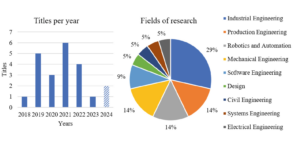
A Literature Review on the Cross-Domain Usage of Digital Factory Twins Within Design Time Proceedings Article
In: Thürer, Matthias; Riedel, Ralph; Cieminski, Gregor; Romero, David (Hrsg.): Advances in Production Management Systems. Production Management Systems for Volatile, Uncertain, Complex, and Ambiguous Environments, S. 315–329, Springer Nature Switzerland, Cham, 2024, ISBN: 978-3-031-71629-4.
Abstract | Links | BibTeX | Schlagwörter: Digital Twin
@inproceedings{10.1007/978-3-031-71629-4_22,

title = {A Literature Review on the Cross-Domain Usage of Digital Factory Twins Within Design Time},

author = {Adrian Schr\"{o}der and Oliver Antons and Julia C. Arlinghaus},

editor = {Matthias Th\"{u}rer and Ralph Riedel and Gregor Cieminski and David Romero},

url = {https://link.springer.com/chapter/10.1007/978-3-031-71629-4_22},

doi = {10.1007/978-3-031-71629-4_22},

isbn = {978-3-031-71629-4},

year  = {2024},

date = {2024-01-01},

urldate = {2024-01-01},

booktitle = {Advances in Production Management Systems. Production Management Systems for Volatile, Uncertain, Complex, and Ambiguous Environments},

pages = {315\textendash329},

publisher = {Springer Nature Switzerland},

address = {Cham},

abstract = {In a globalized production environment companies are confronted with shortening product life cycles leading to shortening factory system life cycles. To overcome this issue, factories have to be (re-)built faster. The design time is a crucial phase in which many different disciplines of different domains have to work together in a major planning project. Currently, various experts in the respective domains of e.g. production system planning, automation and building are commonly working on their silo models resulting in different and sometimes contradictory information depending on the perspective of planning. While model-orientated, collaborative planning approaches like Building Information Modeling (BIM) have become familiar with the domain of factory planning, there is still a lack of combining the different factory data models holistically to connect all elements of production regarding information of products, processes and resources. Besides the BIM methodology several other forms of virtual factory descriptions, like the digital factory twin have emerged. In this work, a systematic literature review is conducted to present the current perspective on creating factory data models about a cross-domain usage and modeling approach. In analyzing the current use case definition of factory models the opportunity is seen to point out the importance of the combination of holistically linked factory data models with a multipurpose design. In doing so, a possibility is seen to overcome the mentioned obstacles of planning while raising the value of the created models. This demonstrates the need for a concept of modeling a digital factory twin, created for cross-domain usage.},

keywords = {Digital Twin},

pubstate = {published},

tppubtype = {inproceedings}

}
Rodrigo Torres Adelsberger; Oliver Antons; Julia C. Arlinghaus
Digital Twins and their Implications for Business Models: Overview and Potentials Artikel
In: IFAC-PapersOnLine, Bd. 58, Nr. 19, S. 409-414, 2024, ISSN: 2405-8963, (18th IFAC Symposium on Information Control Problems in Manufacturing INCOM 2024).
Abstract | Links | BibTeX | Schlagwörter: Business Model, Circular Business Model, Circular Economy, Digital Twin, Digital Twin-enabled Business Model, Industry 4.0, Servitisation, Smart Product-Service System
@article{ADELSBERGER2024409,

title = {Digital Twins and their Implications for Business Models: Overview and Potentials},

author = {Rodrigo Torres Adelsberger and Oliver Antons and Julia C. Arlinghaus},

url = {https://www.sciencedirect.com/science/article/pii/S2405896324016756},

doi = {https://doi.org/10.1016/j.ifacol.2024.09.246},

issn = {2405-8963},

year  = {2024},

date = {2024-01-01},

urldate = {2024-01-01},

journal = {IFAC-PapersOnLine},

volume = {58},

number = {19},

pages = {409-414},

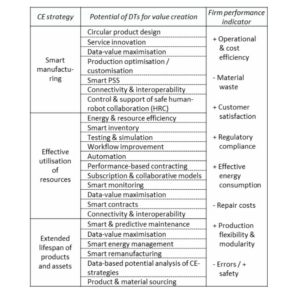
abstract = {Digital Twins are key elements to develop the complex digital systems required for an effective Circular Economy transition. This study explores the intersection of Digital Twins and Business Models within Industry 4.0 and offers a comprehensive theoretical background of the advancements in Digital Twins and their potentials to innovate Business Models. Through a literature review, we identify and discuss eleven Digital Twin-enabled Business Models. The study suggests the necessity of further research efforts to validate theoretical perspectives and identifies future research venues, such as the exploration of Digital Twin-enabled Circular Business Models.},

note = {18th IFAC Symposium on Information Control Problems in Manufacturing INCOM 2024},

keywords = {Business Model, Circular Business Model, Circular Economy, Digital Twin, Digital Twin-enabled Business Model, Industry 4.0, Servitisation, Smart Product-Service System},

pubstate = {published},

tppubtype = {article}

}