2026
Anna-Kristin Behnert; Oliver Antons; Julia Arlinghaus
Data sharing for circular procurement: Uncovering how data sharing can mitigate circular procurement barriers Book Chapter
In: Bode, Christoph; Bogaschewsky, Ronald; Buchholz, Wolfgang; Eßig, Michael; Lasch, Rainer (Ed.): Supply Management Research: Aktuelle Forschungsergebnisse 2026, pp. 147–162, Springer Fachmedien Wiesbaden, Wiesbaden, 2026, ISBN: 978-3-658-52933-8.
Abstract | Links | BibTeX | Tags: Circular Economy, Data Sharing, Procurement
@inbook{Behnert2026,

title = {Data sharing for circular procurement: Uncovering how data sharing can mitigate circular procurement barriers},

author = {Anna-Kristin Behnert and Oliver Antons and Julia Arlinghaus},

editor = {Christoph Bode and Ronald Bogaschewsky and Wolfgang Buchholz and Michael E\ssig and Rainer Lasch},

url = {https://doi.org/10.1007/978-3-658-52933-8_6},

doi = {10.1007/978-3-658-52933-8_6},

isbn = {978-3-658-52933-8},

year  = {2026},

date = {2026-01-01},

urldate = {2026-01-01},

booktitle = {Supply Management Research: Aktuelle Forschungsergebnisse 2026},

pages = {147\textendash162},

publisher = {Springer Fachmedien Wiesbaden},

address = {Wiesbaden},

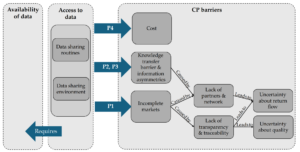
abstract = {Transitioning to a circular economy is critical for companies to achieve long-term economic, environmental, and social benefits in the face of increasing supply chain uncertainties, disruptions and upcoming new regulations. To achieve these benefits circular supply chain management, and especially circular procurement has been identified as crucial enabler. However, existing barriers such as lack of transparency, unavailability of materials, poor quality of secondary materials, lack of cooperation and high costs lead to a situation of unprofitability, and an increase in uncertainties. This paper examines the potential of secure data sharing environments to overcome these challenges and promote circular procurement practices. A systematic review of the existing literature is conducted to identify the key barriers to and potential enabling function of a secure data sharing environment. Subsequently, propositions are derived on the potentials of data sharing to foster circular procurement.},

keywords = {Circular Economy, Data Sharing, Procurement},

pubstate = {published},

tppubtype = {inbook}

}
Transitioning to a circular economy is critical for companies to achieve long-term economic, environmental, and social benefits in the face of increasing supply chain uncertainties, disruptions and upcoming new regulations. To achieve these benefits circular supply chain management, and especially circular procurement has been identified as crucial enabler. However, existing barriers such as lack of transparency, unavailability of materials, poor quality of secondary materials, lack of cooperation and high costs lead to a situation of unprofitability, and an increase in uncertainties. This paper examines the potential of secure data sharing environments to overcome these challenges and promote circular procurement practices. A systematic review of the existing literature is conducted to identify the key barriers to and potential enabling function of a secure data sharing environment. Subsequently, propositions are derived on the potentials of data sharing to foster circular procurement.