2026
Rodrigo Torres Adelsberger; Mathias Vorbröcker; Oliver Antons; Julia C. Arlinghaus
Exploring the Interaction Between Digital Twins and Data Spaces: A Circular Value Creation Perspective Proceedings Article
In: S. 97-106, 2026, ISSN: 1877-0509, (7th International Conference on System-Integrated Intelligence).
Abstract | Links | BibTeX | Schlagwörter: Asset Administration Shell, Circular Business Models, Circular Economy, Data Space, Digital Twin, Industry 4.0
@inproceedings{ADELSBERGER202697,

title = {Exploring the Interaction Between Digital Twins and Data Spaces: A Circular Value Creation Perspective},

author = {Rodrigo Torres Adelsberger and Mathias Vorbr\"{o}cker and Oliver Antons and Julia C. Arlinghaus},

url = {https://www.sciencedirect.com/science/article/pii/S1877050926001286},

doi = {https://doi.org/10.1016/j.procs.2026.02.013},

issn = {1877-0509},

year  = {2026},

date = {2026-01-01},

urldate = {2026-01-01},

journal = {Procedia Computer Science},

volume = {276},

pages = {97-106},

abstract = {Digital Twins and Data Spaces are emerging as key drivers for secure and interoperable data exchange in manufacturing, offering new opportunities to support Circular Economy strategies. While Digital Twins and Data Spaces each contribute foundational enablers, such as interoperable asset data models and trusted policy-based data sharing, their combined potential to unlock circular value creation remains underexplored. We utilise a structured literature review approach to address this knowledge gap and develop a conceptual framework grounded in a Circular Economy perspective. The integration of these foundational enablers can activate four relevant mechanisms (digital product passports, manufacturing platforms, business-to-business marketplaces, and data-driven services) which subsequently may support Circular Economy strategies. These include enhanced lifecycle transparency and traceability, asset life extension through collaborative data sharing, improved resource efficiency via shared production, and the creation of new circular business models. This study has the potential to advance the theoretical understanding of Digital Twin-Data Space integration for circular value creation and provides a foundation for future empirical validation in industrial settings.},

note = {7th International Conference on System-Integrated Intelligence},

keywords = {Asset Administration Shell, Circular Business Models, Circular Economy, Data Space, Digital Twin, Industry 4.0},

pubstate = {published},

tppubtype = {inproceedings}

}
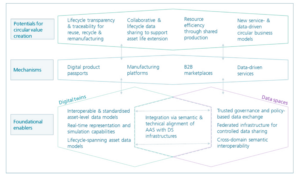
Digital Twins and Data Spaces are emerging as key drivers for secure and interoperable data exchange in manufacturing, offering new opportunities to support Circular Economy strategies. While Digital Twins and Data Spaces each contribute foundational enablers, such as interoperable asset data models and trusted policy-based data sharing, their combined potential to unlock circular value creation remains underexplored. We utilise a structured literature review approach to address this knowledge gap and develop a conceptual framework grounded in a Circular Economy perspective. The integration of these foundational enablers can activate four relevant mechanisms (digital product passports, manufacturing platforms, business-to-business marketplaces, and data-driven services) which subsequently may support Circular Economy strategies. These include enhanced lifecycle transparency and traceability, asset life extension through collaborative data sharing, improved resource efficiency via shared production, and the creation of new circular business models. This study has the potential to advance the theoretical understanding of Digital Twin-Data Space integration for circular value creation and provides a foundation for future empirical validation in industrial settings.