2026
Anna-Kristin Behnert; Oliver Antons; Julia C. Arlinghaus
Beyond Closed Loops: Advancing Climate Change Mitigation by Collaborative Open Approaches Journal Article
In: Business Strategy and the Environment, vol. n/a, no. n/a, 2026.
Abstract | Links | BibTeX | Tags: Circular Economy, Co-creation, Manufacturing, open innovation, open-source, Sustainability, sustainable manufacturing
@article{https://doi.org/10.1002/bse.70898,

title = {Beyond Closed Loops: Advancing Climate Change Mitigation by Collaborative Open Approaches},

author = {Anna-Kristin Behnert and Oliver Antons and Julia C. Arlinghaus},

url = {https://onlinelibrary.wiley.com/doi/abs/10.1002/bse.70898},

doi = {https://doi.org/10.1002/bse.70898},

year  = {2026},

date = {2026-05-05},

journal = {Business Strategy and the Environment},

volume = {n/a},

number = {n/a},

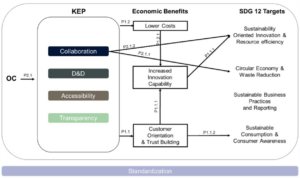
abstract = {ABSTRACT Even as world leaders emphasize the urgency of limiting global warming, a slow transition to a circular economy persists. While climate mitigation efforts focus on renewable energy and efficiency measures, addressing the 45% of emissions from product manufacturing remains critical. While previous research has focused on collaborative approaches like open innovation, other forms like open-source hardware and open data remain understudied. There is a limited understanding of how open concepts and their collaboration mechanisms influence sustainable practices in global value chains. To address this gap, we conduct a structured literature review following the PRISMA guidelines and using the Gioia methodology. Additionally, we analyze 27 cases and derive key enabling properties of open concepts for climate change mitigation, drawing inspiration from the foundational theories of relational view, resource-based view, and knowledge-based view. This study serves as a starting point for future studies on the potentials of open collaboration mechanisms in shaping sustainable practices.},

keywords = {Circular Economy, Co-creation, Manufacturing, open innovation, open-source, Sustainability, sustainable manufacturing},

pubstate = {published},

tppubtype = {article}

}
ABSTRACT Even as world leaders emphasize the urgency of limiting global warming, a slow transition to a circular economy persists. While climate mitigation efforts focus on renewable energy and efficiency measures, addressing the 45% of emissions from product manufacturing remains critical. While previous research has focused on collaborative approaches like open innovation, other forms like open-source hardware and open data remain understudied. There is a limited understanding of how open concepts and their collaboration mechanisms influence sustainable practices in global value chains. To address this gap, we conduct a structured literature review following the PRISMA guidelines and using the Gioia methodology. Additionally, we analyze 27 cases and derive key enabling properties of open concepts for climate change mitigation, drawing inspiration from the foundational theories of relational view, resource-based view, and knowledge-based view. This study serves as a starting point for future studies on the potentials of open collaboration mechanisms in shaping sustainable practices.
2019
Stephanie Knizkov; Oliver Antons; Julia C. Bendul
Designing Inclusive Supply Chains for Sustainability: Empirical Insights from the Bottom of the Global Economic Pyramid Proceedings Article
In: EurOMA19, 2019.
Abstract | BibTeX | Tags: Base of the Pyramid, Co-creation, Sustainability, Sustainable Development
@inproceedings{Knizkov-2019,

title = {Designing Inclusive Supply Chains for Sustainability: Empirical Insights from the Bottom of the Global Economic Pyramid},

author = {Stephanie Knizkov and Oliver Antons and Julia C. Bendul},

year  = {2019},

date = {2019-01-01},

urldate = {2019-01-01},

booktitle = {EurOMA19},

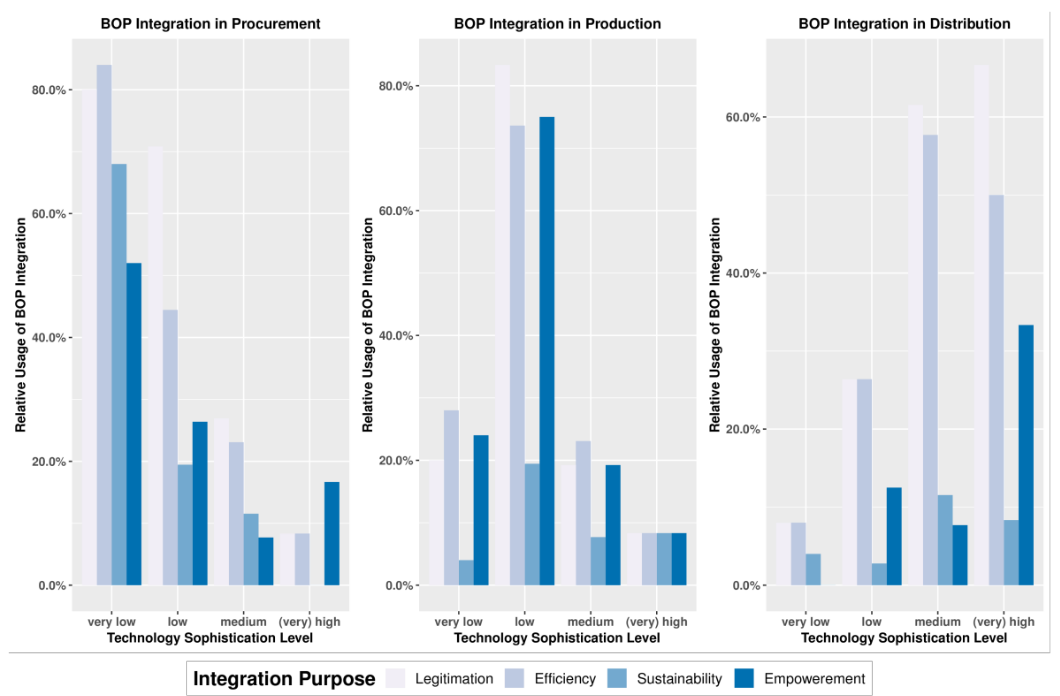
abstract = {Integration of the population at the Bottom of the Pyramid (BOP) within company operations was identified as pivotal for realizing both value for companies operating in these challenging markets, as well as for harnessing the full potential of the BOP proposition in fostering value for individuals living in them. However, research on the topic remains predominantly simplistic, with nuanced and empiric based argumentation relatively scarce. In this paper we address this gap and provide a clear overview of how companies integrate BOP individuals in the different stages of their supply-chain, and how this integration facilitates different levels of sustainability depth.},

keywords = {Base of the Pyramid, Co-creation, Sustainability, Sustainable Development},

pubstate = {published},

tppubtype = {inproceedings}

}
Integration of the population at the Bottom of the Pyramid (BOP) within company operations was identified as pivotal for realizing both value for companies operating in these challenging markets, as well as for harnessing the full potential of the BOP proposition in fostering value for individuals living in them. However, research on the topic remains predominantly simplistic, with nuanced and empiric based argumentation relatively scarce. In this paper we address this gap and provide a clear overview of how companies integrate BOP individuals in the different stages of their supply-chain, and how this integration facilitates different levels of sustainability depth.